Delayed acidification in the cheese vat can be costly in terms of time, quality and food safety. Researchers from the University of Copenhagen have now mapped how new mathematical models – together with the discovery of a specific resistance system – may help dairies anticipate problems before they occur.
Acidification problems during cheese production are a well-known challenge and can lead to unwanted changes in texture and flavour, longer production times and varying moisture content. In the worst cases, failed acidification may even pose a food safety risk.
Today, problems are often only detected through an acidification test once the damage has already occurred. However, a new research project, PhageWarn, led by associate professors Åsmund Rinnan and Finn K. Vogensen from KU-FOOD, has worked to establish the basis for a mathematical prediction model and a future control and monitoring system.
Simulating the reality of the cheese vat
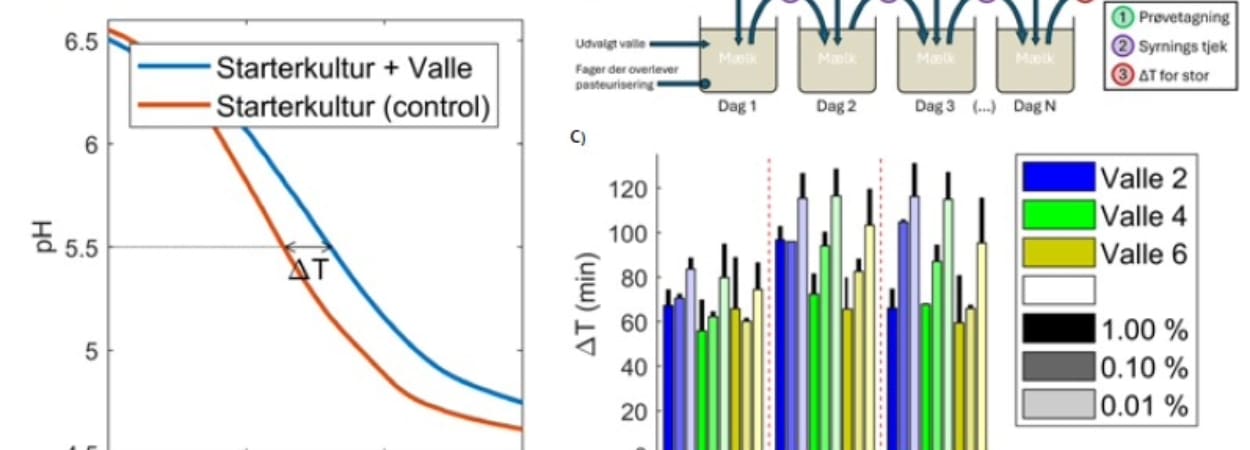
To understand the mechanisms behind inhibited acidification, the researchers recreated a bulk starter production process in the laboratory. Here, starter cultures were sequentially contaminated with whey from previous productions in varying degrees – precisely as may happen in an industrial setting.
Using continuous pH measurement (the ICinac system), the researchers calculated “delta time” (ΔT) – the time difference between normal acidification and inhibited acidification. The results show that this measurement method provides better and more robust results than the current ΔpH-based approach used to identify emerging problems.
Surprising discovery: bacteria with their own defence
As part of the project, 400 bacterial isolates were genome sequenced. This led to a discovery that could influence the development of future starter cultures:
The explanation is likely to lie in a previously unknown resistance system in starter cultures called CBASS I. This is the first time the system has been observed in this context, and the researchers believe that this mechanism in the dominant population of Lactococcus cremoris is capable of stopping phage infections.
Towards an automated control system
Although the project has generated new insights into phage biology and resulted in new primer sets for identifying phage groups, the final step remains before dairies can implement a complete system.
The objective is clear: by combining predictive mathematical models with rapid analytical methods such as qPCR, dairies may in the future be able to estimate acidification inhibition automatically – before production is critically affected.
Read the full research article HERE (in Danish).
By Maja Løvstrup
Illustration: University of Copenhagen / Danish Dairy Research Foundation