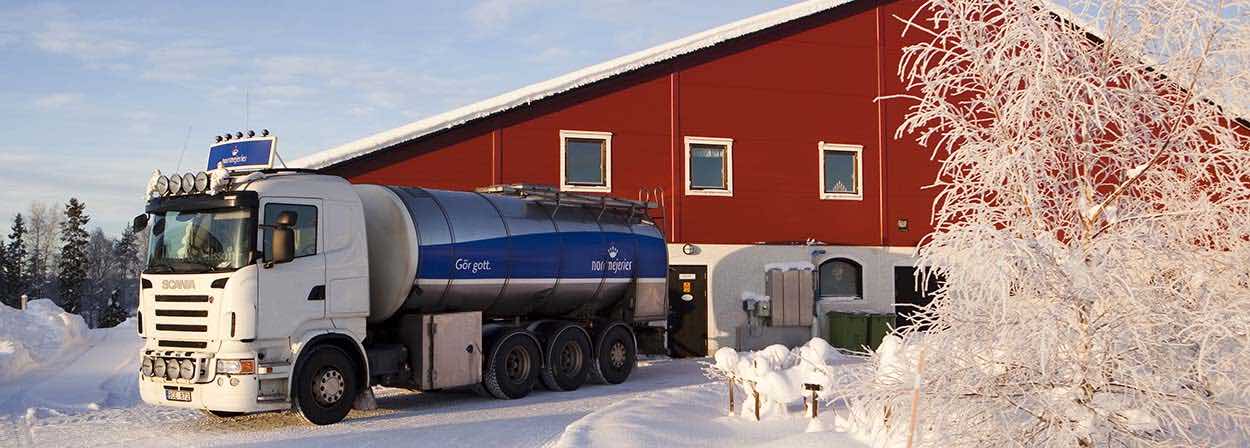
Long distances and an uneven cost structure are placing dairy operations in northern Sweden under pressure. Norrmejerier is calling for political action if supply security is to hold — including in crisis scenarios.
One of Sweden’s largest regional dairy co-operatives, Norrmejerier, is warning of rising costs for milk collection and distribution in the northern parts of the country. The warning comes in an opinion piece published in Västerbottens-Kuriren to coincide with Swedish Prime Minister Ulf Kristersson’s visit to Burträsk dairy.
According to Norrmejerier, operating a dairy business in sparsely populated areas with long distances is significantly more expensive.
“On average, it is almost 90 per cent more expensive to distribute dairy products to inland areas than to coastal towns,” the co-operative writes in the piece.
Deliveries to inland areas account for 31 per cent of volume but 45 per cent of transport costs. In total, this represents an annual additional expenditure of at least 20 million Swedish kronor.
Calls for a whole-chain approach to supply security
Norrmejerier argues that the challenge is not solely a question of operational efficiency, but also one of preparedness and supply security.
“Producing more milk in the north plays a limited role in a crisis if the infrastructure to bring products to market cannot hold,” the piece states.
The co-operative points out that current policy efforts are focused primarily on primary production, while central parts of the value chain — collection, processing and distribution — have received less attention in preparedness planning.
A challenge with Nordic resonance
The issue is not exclusively Swedish. Across the Nordic region, geography and population density play a significant role in the logistics and cost structures of dairy operations — particularly in peripheral areas, where commercial viability and the obligation to supply can be difficult to reconcile.
Norrmejerier is calling for more targeted support schemes for transport and infrastructure, so that supply chains can be maintained both in everyday conditions and during crises.
By Maja Løvstrup
Photo: Norrmejerier