Climate requirements, cyber threats and geopolitical instability have made resilience and security of supply central priorities across the Nordic dairy sector.
Geopolitical tensions, cyber threats, the energy crisis and tightening climate requirements have significantly changed the conditions for dairy production in recent years. As a result, resilience and security of supply are now playing a much greater role across the Nordic dairy industry.
That is the key message in a major feature article in Mælkeritidende, where dairies, farmers and suppliers alike point to the fact that resilience can no longer be separated from efficient operations.
Efficiency alone is no longer enough
At Arla Foods, the shift is already clearly visible.
“Food safety and efficiency have always been fundamental to the dairy industry. What has changed is that we now see them in the context of other central elements – sustainability, resilience and self-sufficiency. Together, they form our overall understanding of a robust supply chain,” says Christian Granlund, Senior Vice President for Supply Chain at Arla Foods.
According to him, a single-minded focus on efficiency may prove costly in the long term.
“If you single-mindedly pursue efficiency without accounting for the likelihood and consequences of disruption, the bill can ultimately be very high. And it is a bill that someone has to pay,” he says.
Resilience begins at farm level
Leif Friis Jørgensen, Managing Director of Naturmælk, also stresses that resilience begins with milk production itself.
“If we do not have a viable milk production, we do not have a resilient dairy industry either. The two are inextricably linked,” he says.
Among other initiatives, Naturmælk is working to reduce dependence on imported raw materials such as soya and strengthen self-sufficiency among its farmers.
Suppliers are also experiencing new demands from dairies. At Novonesis, issues such as stability, risk management and robust processes are playing a greater role than before, while Au2mate is seeing increasing demand for cyber security, real-time data and AI-based monitoring.
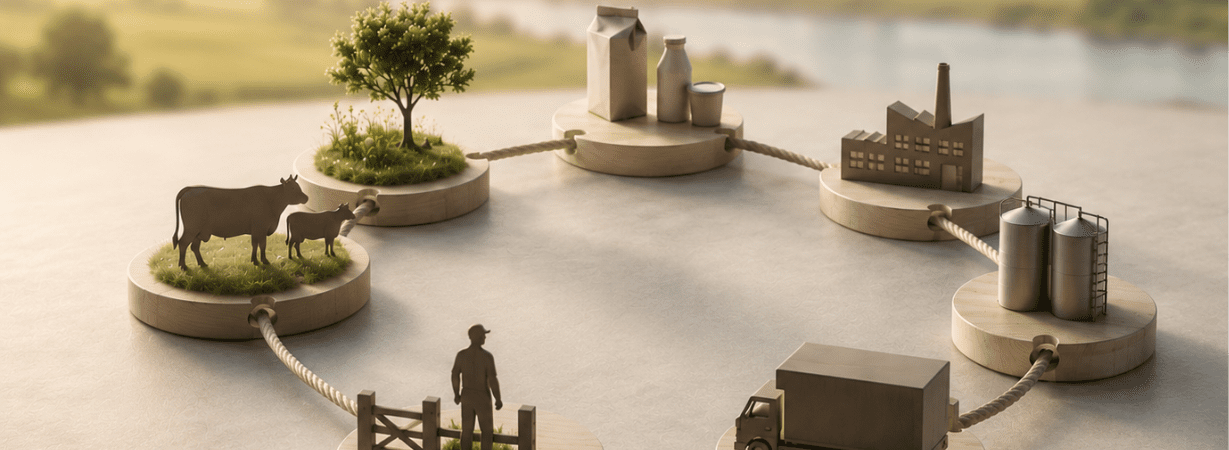
According to Christian Granlund, the conclusion is clear: resilience has become a shared responsibility across the entire value chain.
Read the full article in Mælkeritidende no. 4, published on 12 June.
By Maja Løvstrup
Photo: Mejerimedier