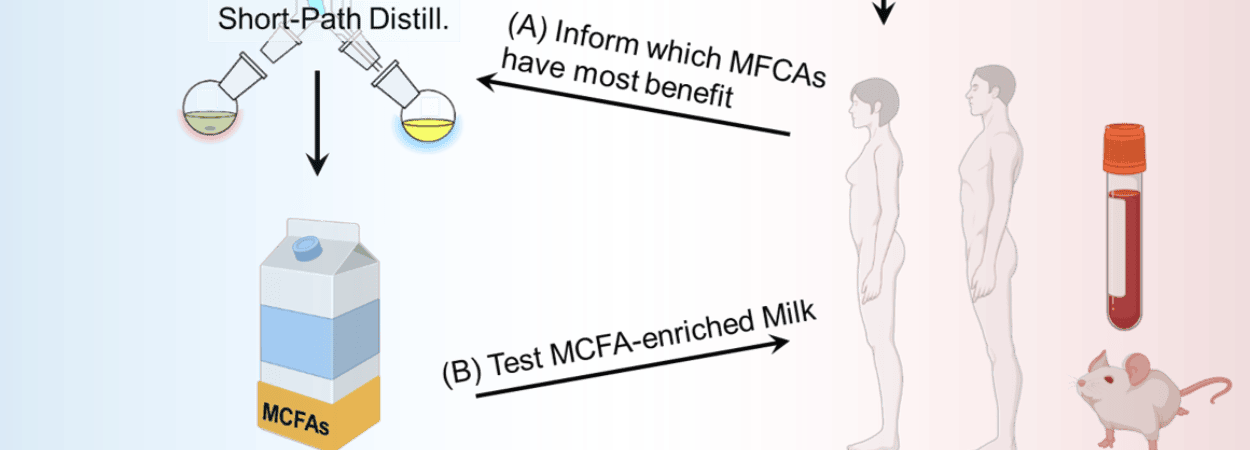
A research collaboration between the University of Copenhagen and Aarhus University has developed a method for enriching milk fat with short- and medium-chain fatty acids, which lowered blood sugar and increased energy expenditure in trials on both mice and humans.
Milk fat has long had a mixed reputation in the health debate. However, a new research project shows that certain fatty acids in milk can in fact have beneficial effects on metabolism – and that it is possible to concentrate them in milk fat using an industrial distillation technique.
This is according to a team of researchers from the University of Copenhagen and Aarhus University, writing in issue 6 of the Danish dairy trade journal Mælkeritidende, published on 18 September. The researchers behind the project include Associate Professor Andreas M. Fritzen and Professor Bente Kiens of the Department of Nutrition, Exercise and Sports at the University of Copenhagen, and Associate Professor Lars Wiking of the Department of Food Science at Aarhus University.
Medium-chain fatty acids improve insulin sensitivity
According to the article, medium-chain fatty acids (MCFA) make up around 10 per cent of the total fat content of milk. Milk is one of the few common dietary sources of this type of fatty acid, which is otherwise found mainly in coconut oil and palm kernel oil.
In earlier trials, the researchers showed that replacing 30 grams of long-chain fatty acids with medium-chain fatty acids in the diet over three days of overeating can prevent the development of insulin resistance. In their latest project, they found that consuming 35 grams of MCFA lowered post-meal blood sugar and increased energy expenditure – without raising blood triglyceride levels, as is otherwise seen when comparable amounts of long-chain fatty acids are consumed. The effect was present both in healthy participants and in people with overweight and metabolic disorders, and it persisted after eight days of daily intake.
The liver releases signalling molecules in response to the fatty acids
The research team has also mapped part of the underlying biology. In trials on mice, they identified two signalling molecules, GDF15 and FGF21, which the liver releases in response to the intake of medium-chain fatty acids. Using genetically modified mice lacking these two hormones, the researchers showed that GDF15 and FGF21 are necessary for the fatty acids to induce satiety and reduce fat content in the liver.
New distillation method doubles MCFA content
To put the findings to practical use, the researchers have developed a method for enriching milk fat with medium- and short-chain fatty acids using a technique known as short-path distillation (SPD). By selecting milk with a high content of medium-chain fatty acids and applying this heating technique, they doubled the proportion of MCFA in the milk fat from 10.1 to 20.2 per cent. At the same time, the content of short-chain fatty acids rose from 6.9 to 15 per cent, whilst the vitamin E content increased markedly. According to the article, milk fat from Jersey cows gave a slightly higher yield than that from other breeds.
The method does, however, pose a challenge: only 8–12 per cent of the original milk fat ends up as enriched distillate. The researchers have therefore also examined the residual product – the so-called retentate, which accounts for around 90 per cent of the volume – and conclude that it has the same functionality and stability as conventional anhydrous milk fat. According to the researchers, this means the method can be used industrially without generating an unusable by-product.
Prospects for the dairy industry
Trials with the enriched milk fat in both mice and humans showed increased production of ketone bodies, lower blood sugar and – in mice – reduced food intake. The researchers point out that the findings could pave the way for new functional dairy products aimed at consumers focused on metabolic health, and that the technology could also add value to milk fat through new processing technology.
Read more in issue 6 of Mælkeritidende, published on 18 September.
By Maja Løvstrup
Illustration: University of Copenhagen / Aarhus University