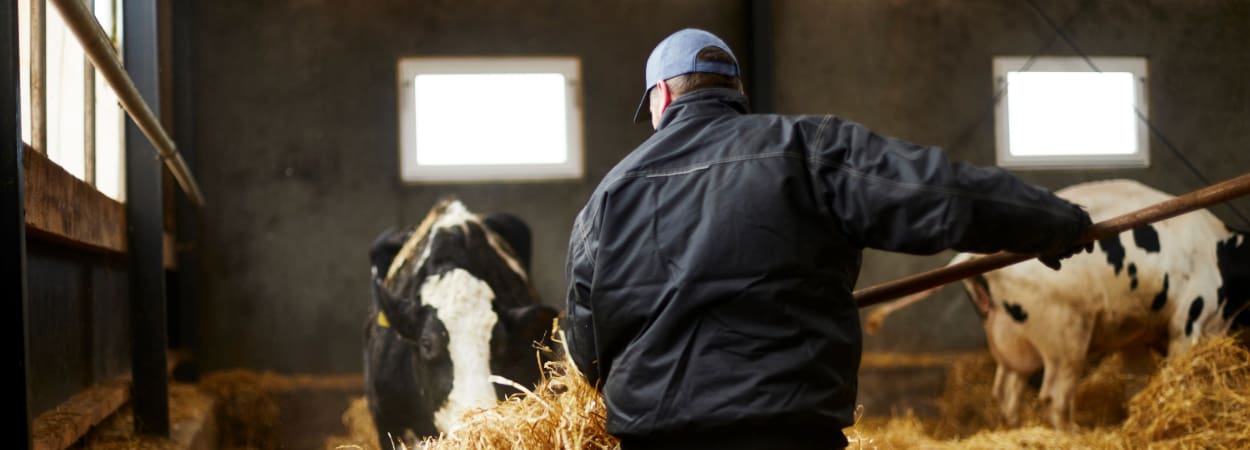
Ten Danish Arla farmers have worked systematically with data and advice on feed as part of a pilot project with McDonald’s Denmark. The experience gained is now to be rolled out to more than 200 farms in Arla’s Danish farmer network.
Danish food production must deliver more food for a growing population whilst agriculture uses fewer resources. That is the background for a pilot project between Arla, McDonald’s Denmark and ten Danish Arla farmers, which has focused on feed efficiency – that is, how much the cows get out of the feed they are given.
According to Arla, feed efficiency among the ten farmers improved by an average of 3.4 per cent in 2025 compared with the project’s baseline year of 2024. Arla notes that the improvement cannot be attributed to the project’s measures alone, and also reflects the economic conditions for milk production, which affect farmers’ incentives and scope for working on feed efficiency.
Better data on feed quality has been key
A more precise adaptation of feeding to the cows’ needs has, according to Arla, been an important factor behind the improvement. The ten farms have worked systematically on feed quality and composition, including having home-produced feed analysed for quality and nutrient content, and compiling more targeted feed rations for individual groups of animals.
“The project shows that there is significant potential in working even more purposefully with feed efficiency. When farmers get the right data, concrete targets and close advisory support, they can optimise production in a way that can both strengthen the farm’s finances and improve resource use. These are the experiences we now want to share widely, so that more farmers can be inspired and learn from the project’s results,” says Mette Ulsø Kristensen, Head of Sustainability at Arla Denmark.
The project forms part of Arla’s FarmAhead™ work, in which data, advice and concrete projects are used to support farmers in developing the dairy production of the future.
McDonald’s sees the project as part of its own climate work
For McDonald’s Denmark, the project is also part of efforts to reduce the carbon footprint of the restaurant chain. Arla supplies all the milk and oat drink to McDonald’s Danish restaurants – more than five million litres of milk and 85,000 litres of oat drink annually in total – and the participating farms supply the milk pool that forms part of the chain’s value chain.
“As a major food buyer, we have both an opportunity and a responsibility to engage with the parts of the value chain where we can contribute to concrete improvements. That is why we have invested in this project, so that we can help create more knowledge, better data and practical experience that can be used out on the farms,” says Linda Nordgren, Chief Sustainability Officer at McDonald’s Nordic.
She points out that efforts to reduce the carbon footprint of the products the chain serves begin long before the raw materials reach the restaurants, and that this requires collaboration with those who produce the food.
Experience is now to reach more than 200 farms
Based on the pilot project, Arla and McDonald’s Denmark will now share knowledge and experience with more than 200 Arla farms. The ambition is to strengthen data-driven advisory work and support a more systematic approach to feed efficiency across Arla’s Danish farmer network.
By Maja Løvstrup
Photo: Arla Foods